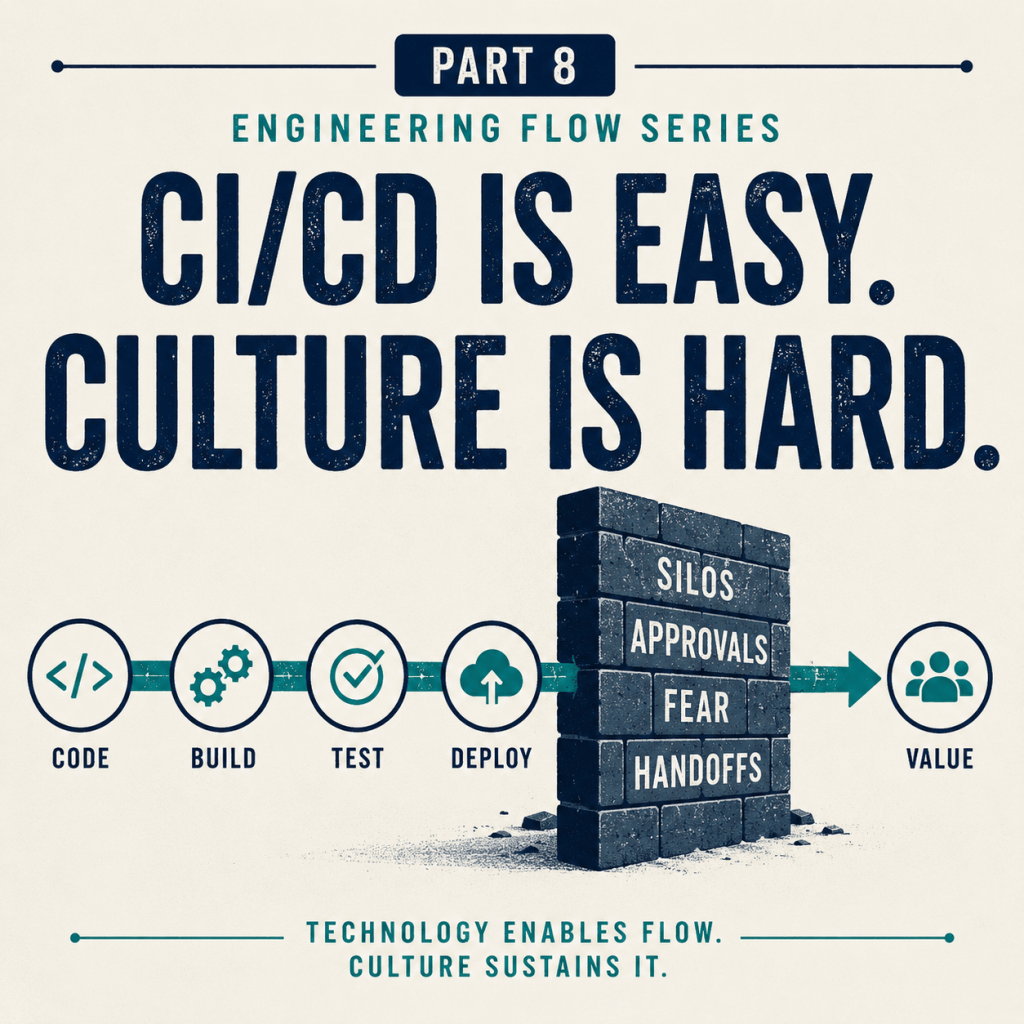
Engineering Flow — Part 8
A series exploring how high-performing engineering organizations improve the flow of software delivery through DevOps, Platform Engineering, DORA Metrics, and systems thinking.
You can build a CI/CD pipeline.
You can automate testing, deployments, infrastructure provisioning, and rollback.
You can implement observability, feature flags, and deployment strategies that dramatically reduce the technical risk of releasing software.
And still fail at DevOps.
Because the hardest part of DevOps was never the tooling.
It was changing how people work together.
The Pipeline Isn’t Usually the Bottleneck
Organizations often begin a DevOps transformation by buying tools.
New CI/CD platform.
New cloud platform.
New observability stack.
New ticketing system.
New automation framework.
Six months later, the technology has changed, but the organization operates almost exactly the same way.
Developers still throw work over the wall to operations.
Operations still becomes the last line of defense before production.
Security still arrives near the end of the delivery process.
Failures still trigger questions about who caused the problem.
Teams still need approvals from people far removed from the work.
The pipeline might be faster. But the organization isn’t.
That’s because DevOps is not primarily a technology transformation.
It is an organizational transformation.
At its core, DevOps is a culture. All the tooling in the world cannot compensate for a poor DevOps culture.
And when I say culture, I’m not talking about whether a company is a great place to work. I’m talking specifically about a culture built around DevOps principles.
Do teams understand those principles? Are people empowered to make decisions through that lens? Do development, operations, security, and other teams see themselves as parts of the same delivery system?
You can implement DevOps tools without ever adopting DevOps.
That distinction matters.
Trust Is the Foundation
High-performing engineering organizations operate on trust.
Teams are trusted to make decisions.
Engineers are trusted to deploy changes.
People closest to the work are trusted to understand the risks associated with it.
That doesn’t mean removing controls.
It means designing controls that enable teams to move safely without requiring someone to manually approve every decision.
There is a significant difference between governance and bureaucracy.
Good governance creates guardrails.
Bureaucracy creates gates.
And too many gates create frustration, delay, and eventually a demoralized workforce.
When organizations lack trust, they compensate with approvals, handoffs, meetings, tickets, and committees.
Every one of those can become another queue in the delivery system. Another point of friction and delay between an idea and the customer.
Shared Ownership Changes Everything
One of the most damaging phrases in technology is: “That’s not my team.”
DevOps challenges that mindset.
Developers don’t simply own code until it reaches production.
Operations doesn’t simply inherit whatever development creates.
Security isn’t someone else’s responsibility.
The team owns the outcome.
When something breaks in production, the first question shouldn’t be: “Who caused this?”
It should be: “What allowed this to happen, and how do we improve the system?”
That distinction matters.
Blameless Doesn’t Mean Accountable-Free
Blameless postmortems are sometimes misunderstood as avoiding accountability.
They are actually about improving it.
If an engineer makes a mistake and the organization stops at “the engineer made a mistake,” very little has been learned.
Why was the mistake possible?
Why didn’t automated testing catch it?
Why didn’t monitoring detect it sooner?
Why was the blast radius so large?
Why was recovery difficult?
The goal of a postmortem isn’t to identify the person responsible.
It is to identify how the system can become more resilient.
People make mistakes.
Great engineering organizations design systems that expect them.
Psychological Safety Is a Delivery Capability
Imagine an engineer notices something concerning during a deployment, but they aren’t completely sure it is a problem.
Do they speak up?
That decision may have more to do with your engineering culture than your technology.
If people are punished for being wrong, eventually they stop raising concerns.
If failures are used to assign blame, people learn to hide mistakes.
If challenging a decision creates career risk, people stop challenging decisions.
And when that happens, organizations lose one of their most valuable feedback mechanisms: their own people.
Psychological safety isn’t about making everyone comfortable.
It is about making it safe to surface uncomfortable information.
Feedback Loops Drive Improvement
DevOps organizations shorten feedback loops everywhere.
Developers get feedback from automated tests.
Teams get feedback from deployments.
Products get feedback from customers.
Systems provide feedback through telemetry.
Incidents provide feedback about architecture and processes.
Teams provide feedback to each other.
The faster that information travels, the faster the organization can learn.
But feedback only matters when the culture is willing to hear it.
A dashboard can tell you deployment frequency is falling.
A retrospective can tell you why.
An engineer can tell you what needs to change.
The question is whether the organization listens.
Continuous Improvement Is the Operating Model
DevOps isn’t a destination.
There is no final pipeline, perfect architecture, or completed transformation.
There is only the next constraint.
Find it.
Understand it.
Improve it.
Then find the next one.
Sometimes the constraint will be technical.
But often, it won’t be.
It might be an approval process.
A team boundary.
A lack of ownership.
A fear of failure.
An incentive that encourages the wrong behavior.
Or simply, “That’s how we’ve always done it.”
The organizations that become great at software delivery aren’t the ones that never have problems.
They are the ones that become exceptionally good at learning from them.
The Real DevOps Transformation
CI/CD is important.
Automation is important.
Cloud is important.
Platform engineering is important.
But none of them creates DevOps by itself.
You can modernize every tool in your technology stack and still operate with the same silos, handoffs, fear, and bureaucracy you had before.
The real transformation happens when teams trust one another, share ownership of outcomes, surface problems without fear, shorten feedback loops, and continuously improve the system around them.
Technology enables DevOps.
Culture determines whether it works.
DevOps is primarily an organizational change, not a tooling change.
Engineering Flow Series
- Your Team Isn’t Slow. Your Delivery System Is.
The foundation of Engineering Flow: why software delivery is constrained more by systems than by individual effort. - Every Dependency Is a Tax on Delivery
Why team dependencies reduce autonomy and slow delivery - Why Platform Engineering Exists
How platforms enable autonomy without sacrificing governance. - CI/CD Isn’t About Automation. It’s About Reducing Risk.
Why smaller deployments are actually safer deployments. - Every Handoff Is a Queue
The hidden cost of waiting, approvals, and organizational bottlenecks. - Stop Measuring Output. Start Measuring Flow.
Why engineering effectiveness starts with measuring systems, not activity. - DORA Metrics Aren’t KPIs
How to use DORA Metrics to improve systems, not evaluate people. - CI/CD Is Easy. Culture Is Hard. (Current Article)
Why trust, ownership, and feedback matter more than tooling. - Why Engineering Leaders Should Care About DORA Metrics
Using engineering metrics to improve organizational performance. - Why Most Data Engineering Teams Aren’t Practicing DevOps
Applying modern software delivery principles to data platforms.
If you enjoyed this article, consider subscribing for future posts in the Engineering Flow series.


Leave a Reply